Atmosphere Labs
Atmosphere is not a finishing quality.
It is a medium of architectural design.
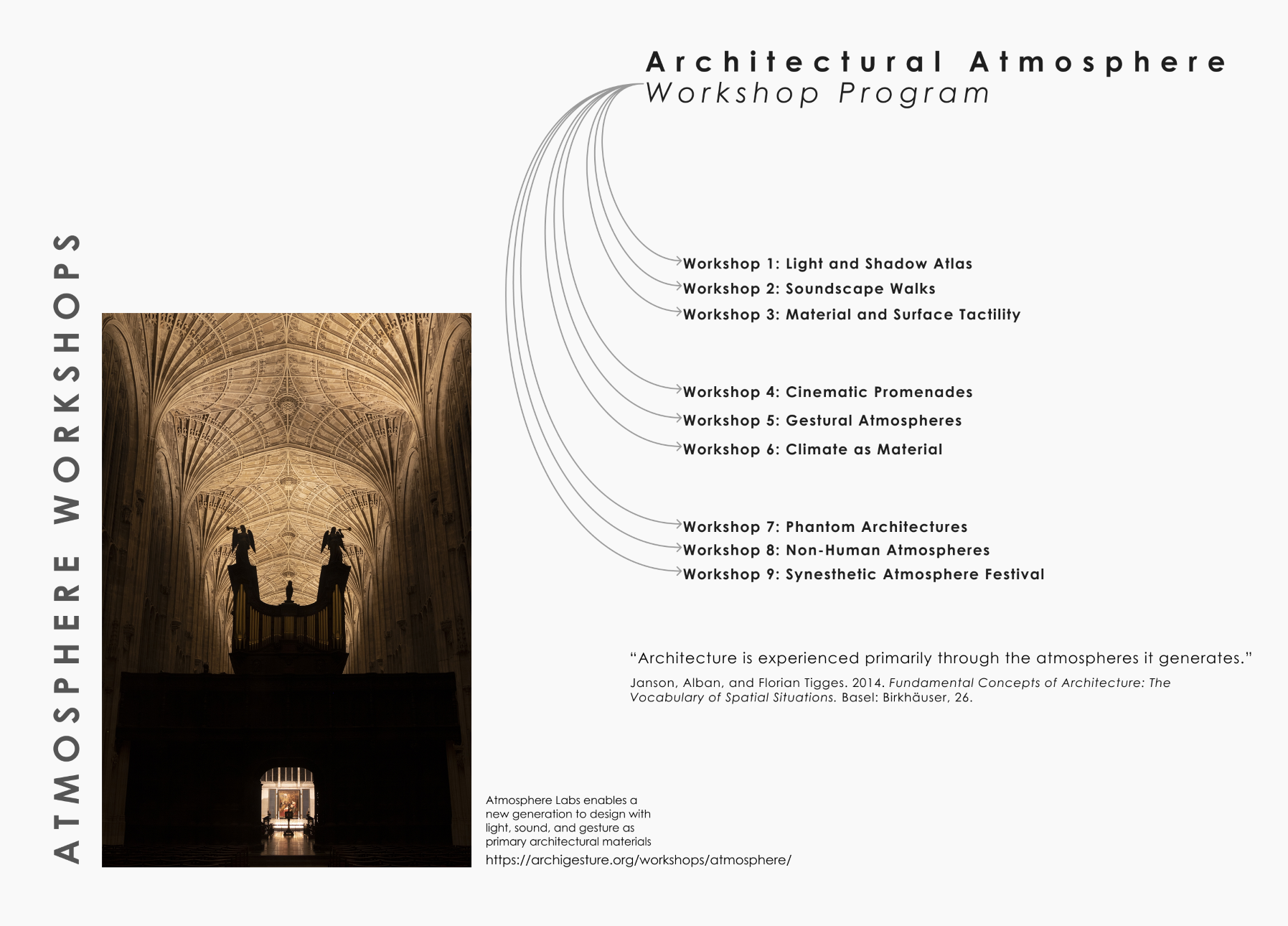
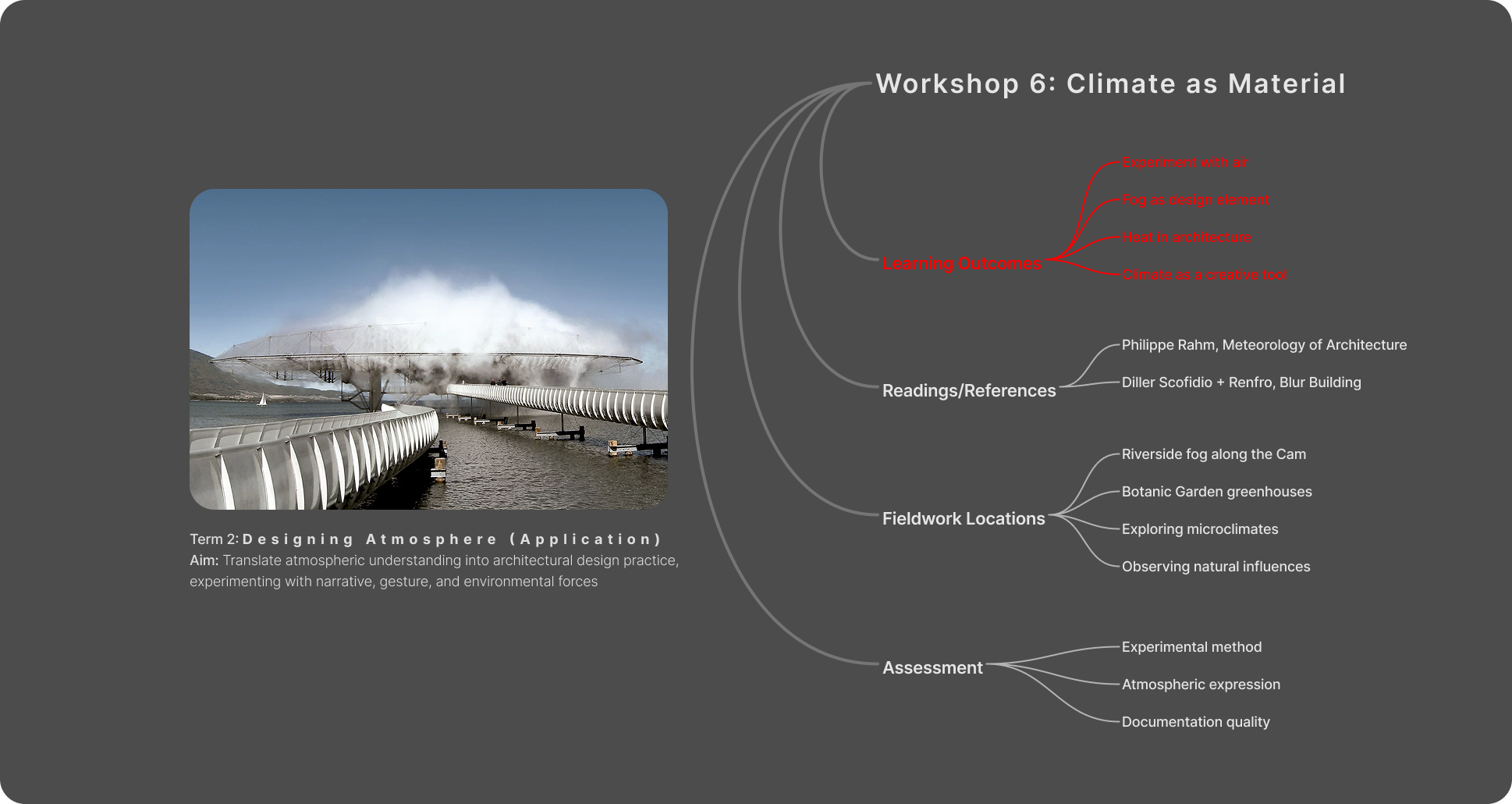
Atmosphere Labs investigates how light, sound, material, climate, and movement shape spatial experience, and how atmospheric conditions can become active materials of architectural design.
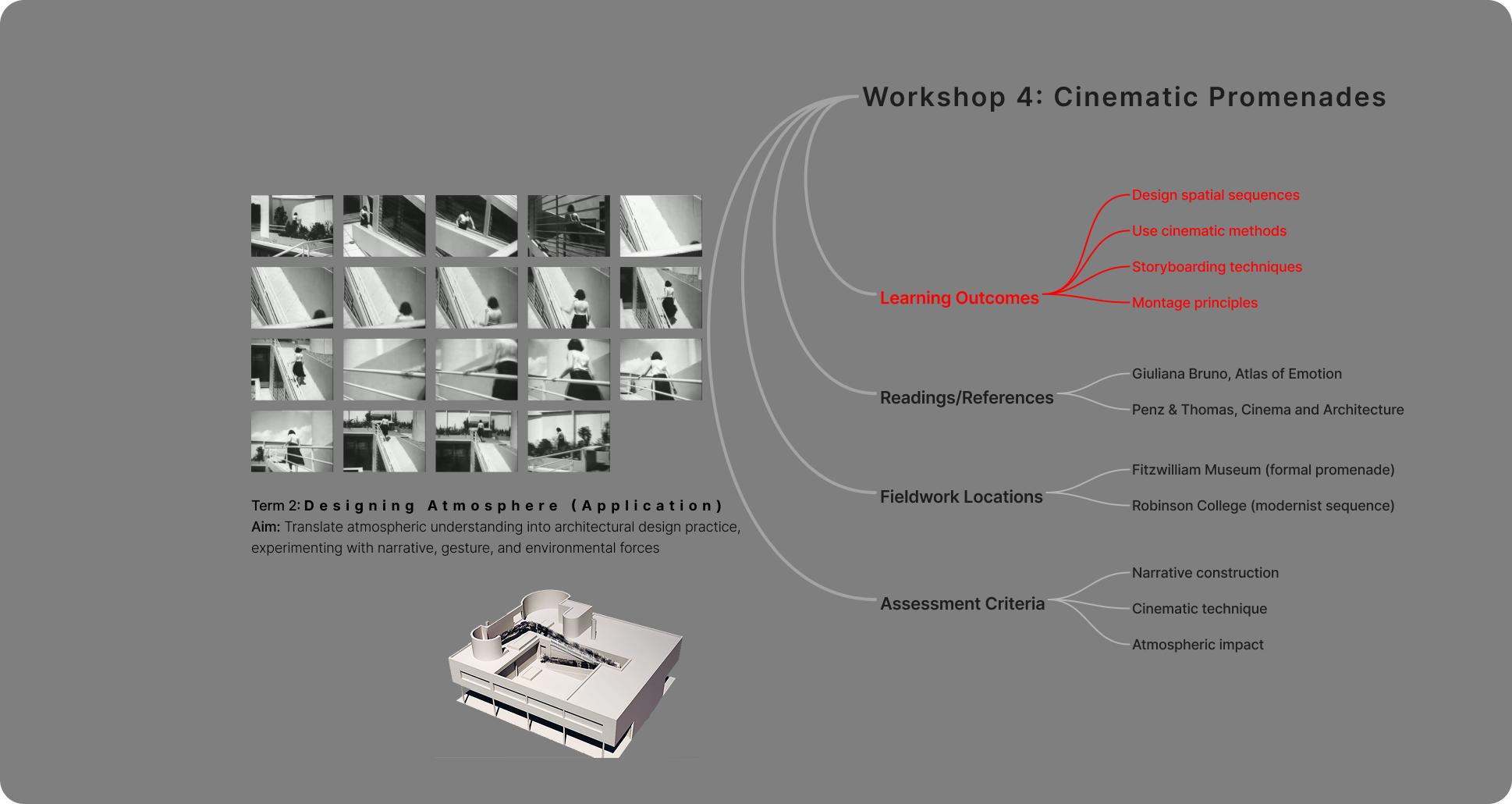
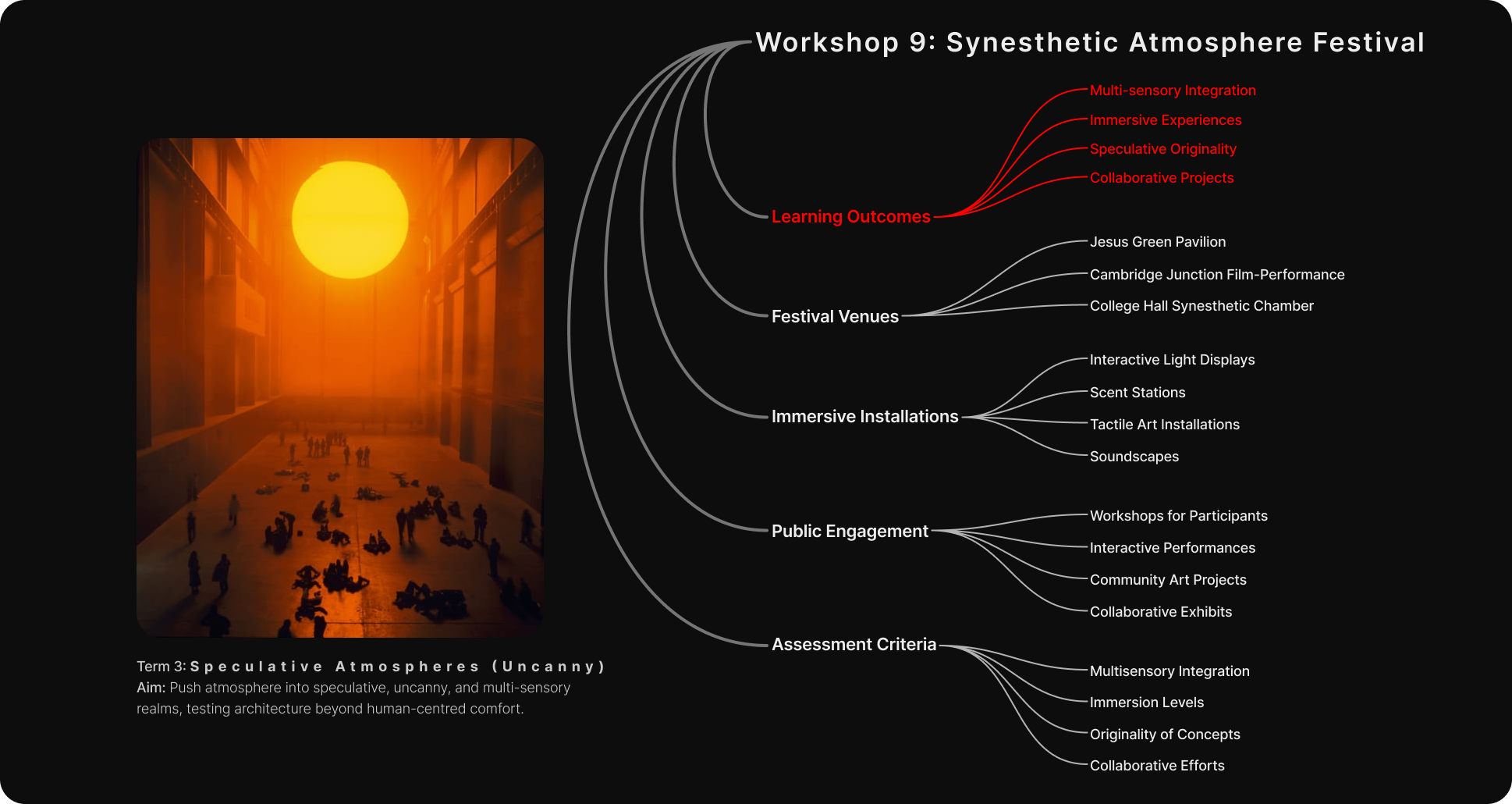
The programme develops through three modes of inquiry. Mapping Atmosphere examines existing sensory and environmental conditions. Designing Atmosphere translates observations into spatial and material experiments. Speculative Atmospheres explores unfamiliar, imagined, and multisensory environments.
Through observation, making, and interdisciplinary experimentation, the labs investigate the relationship between atmospheric perception and architectural form. They provide a setting for testing how atmosphere can generate spatial ideas, inform design decisions, and transform the experience of space.
AtmosScore
 AtmosScore is an experimental computational design plugin for Grasshopper that investigates how atmospheres experienced through film can be interpreted, scored, and translated into architectural configurations. It treats cinematic sequences as temporal constructions in which light, spatial enclosure, material presence, movement, and thresholds change in relation to one another.
AtmosScore XR evaluation
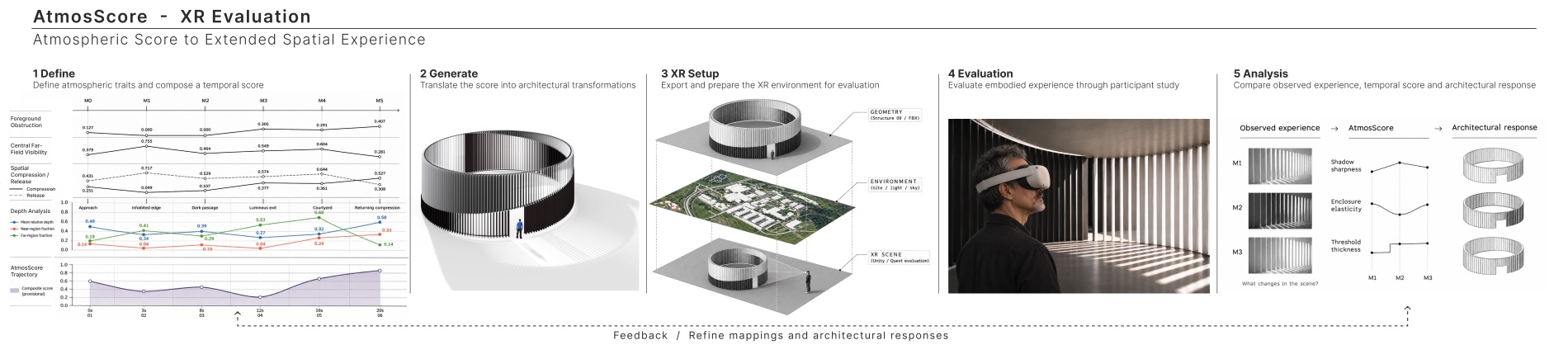
The XR evaluation investigates how atmospheric interpretations, translated into temporal scores and architectural transformations, are experienced in an immersive environment. Participants explore the resulting spatial configurations, providing a basis for comparing observed experience, scored conditions and architectural response. The findings will inform the refinement of AtmosScore’s mappings and generative operations.
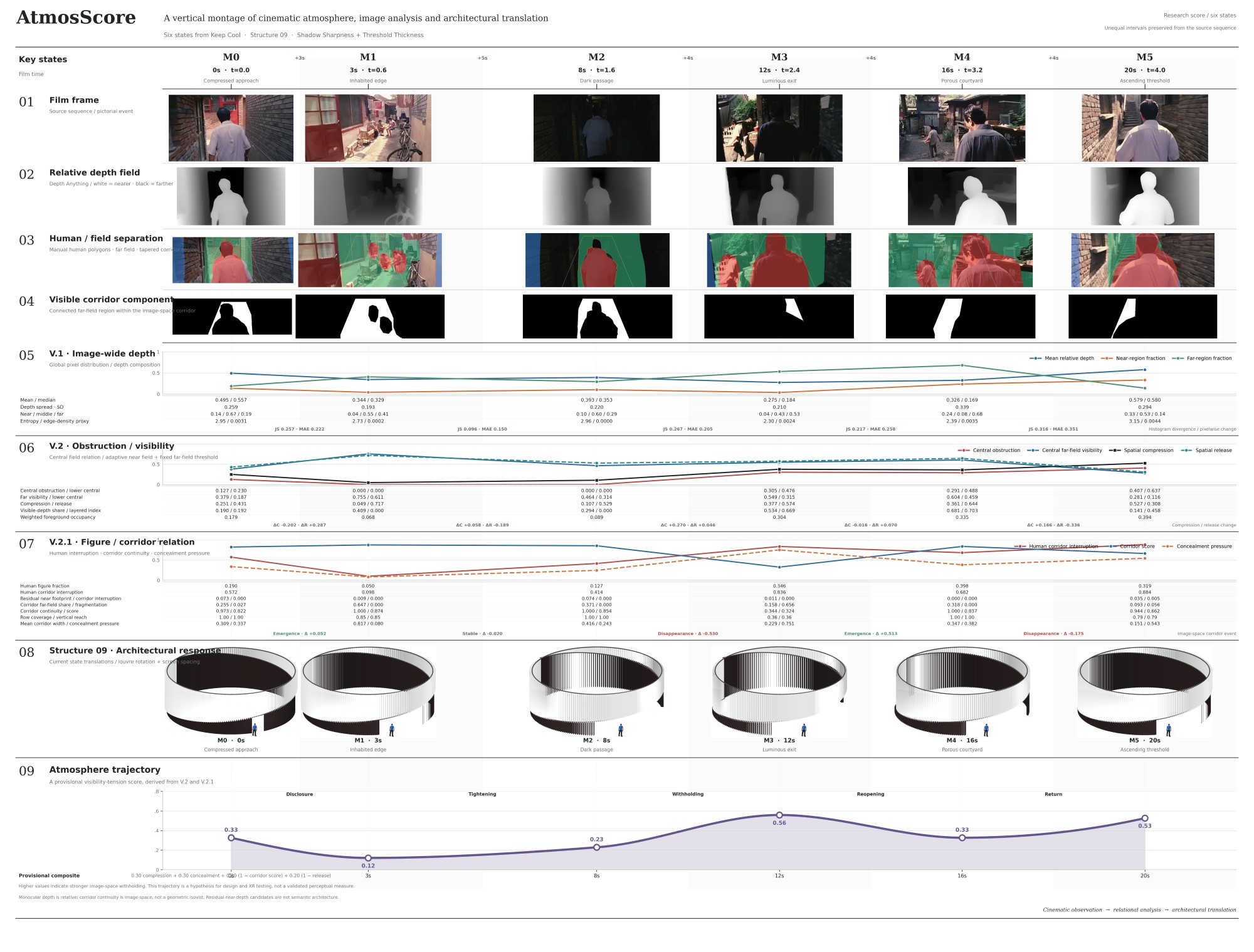
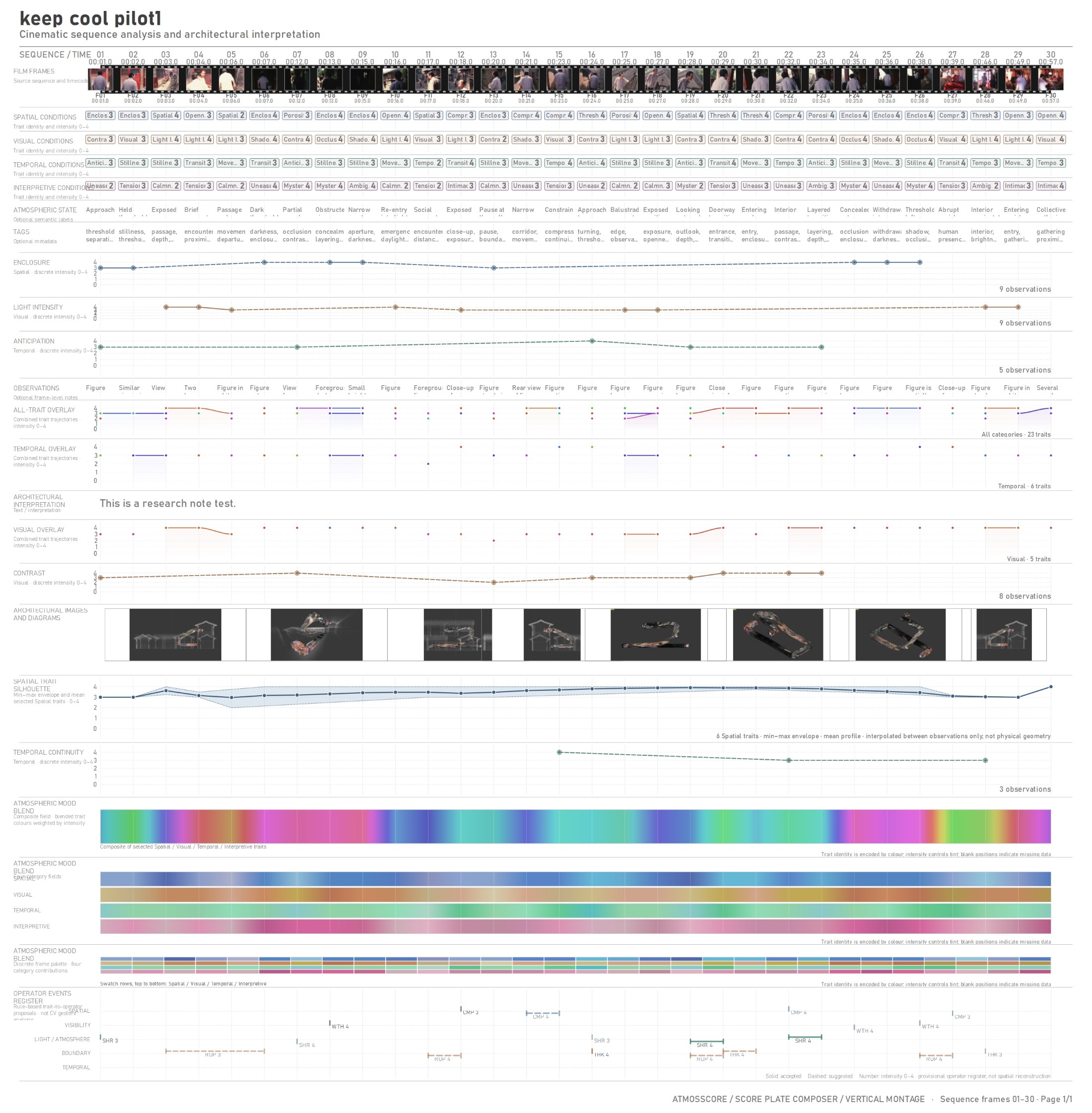
AtmosScore Vertical Analysis v.2.1
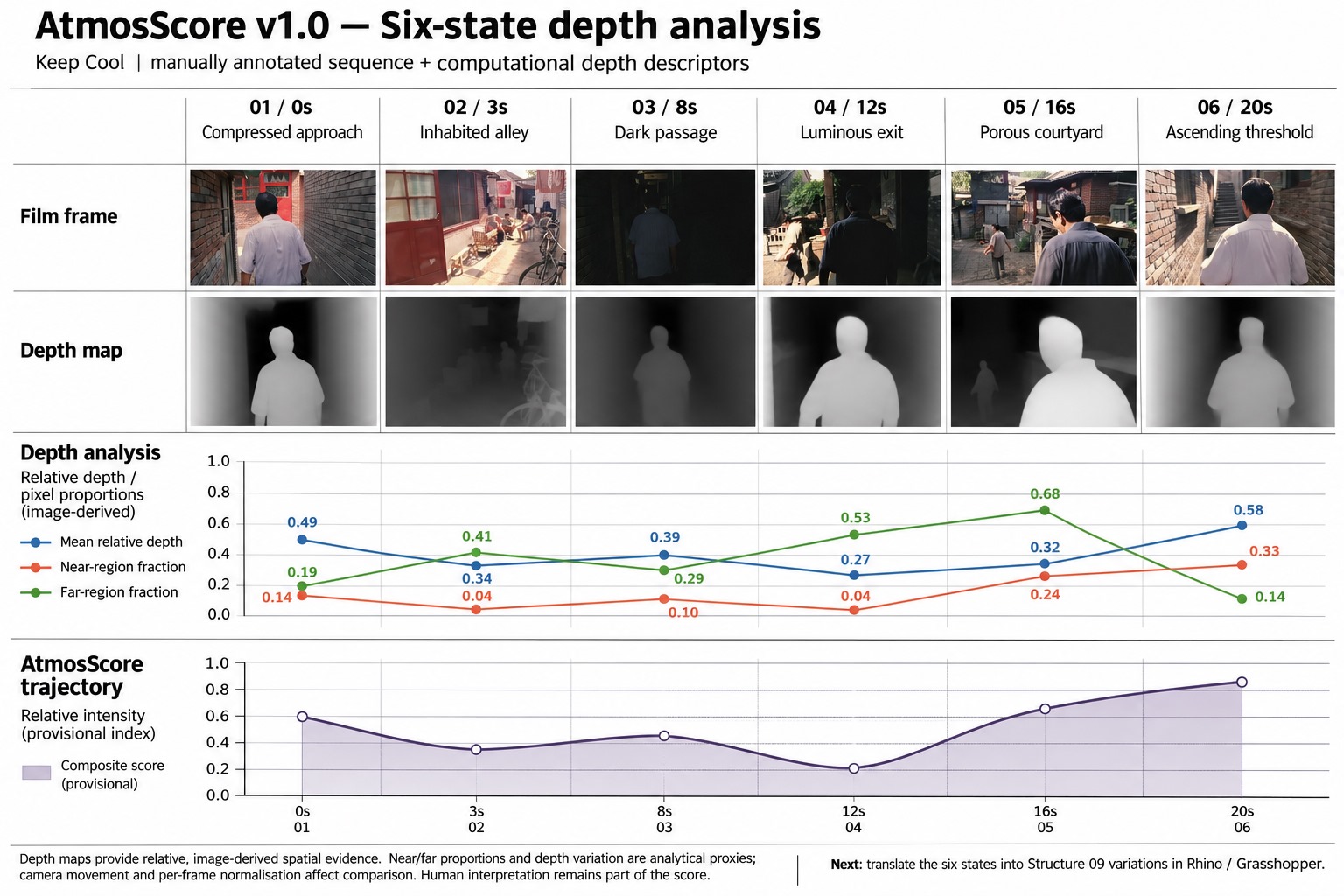
AtmosScore Depth Anlysis
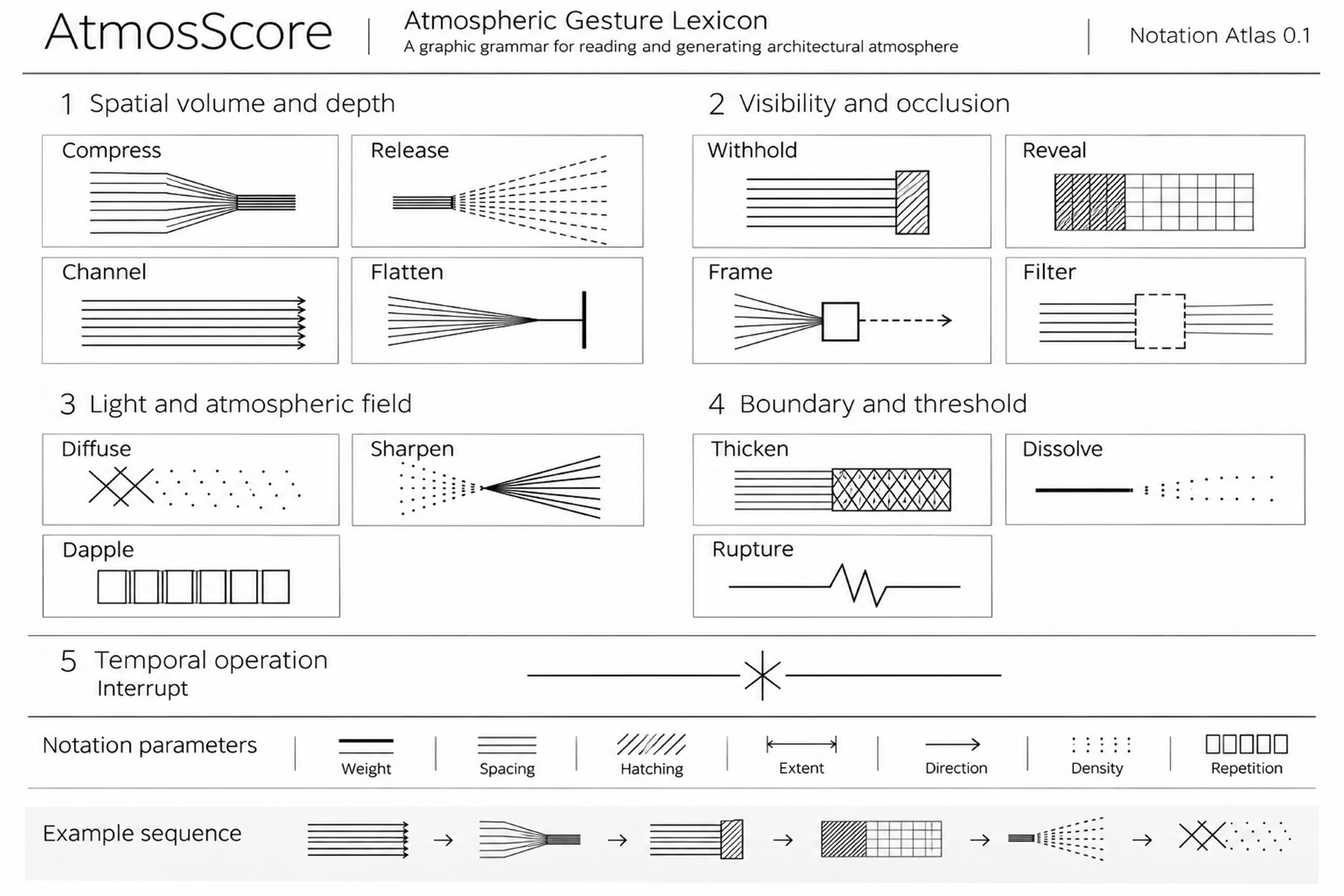
AtmosScore Initial Graphic Lexicon
AtmosScore Plate Composer Module
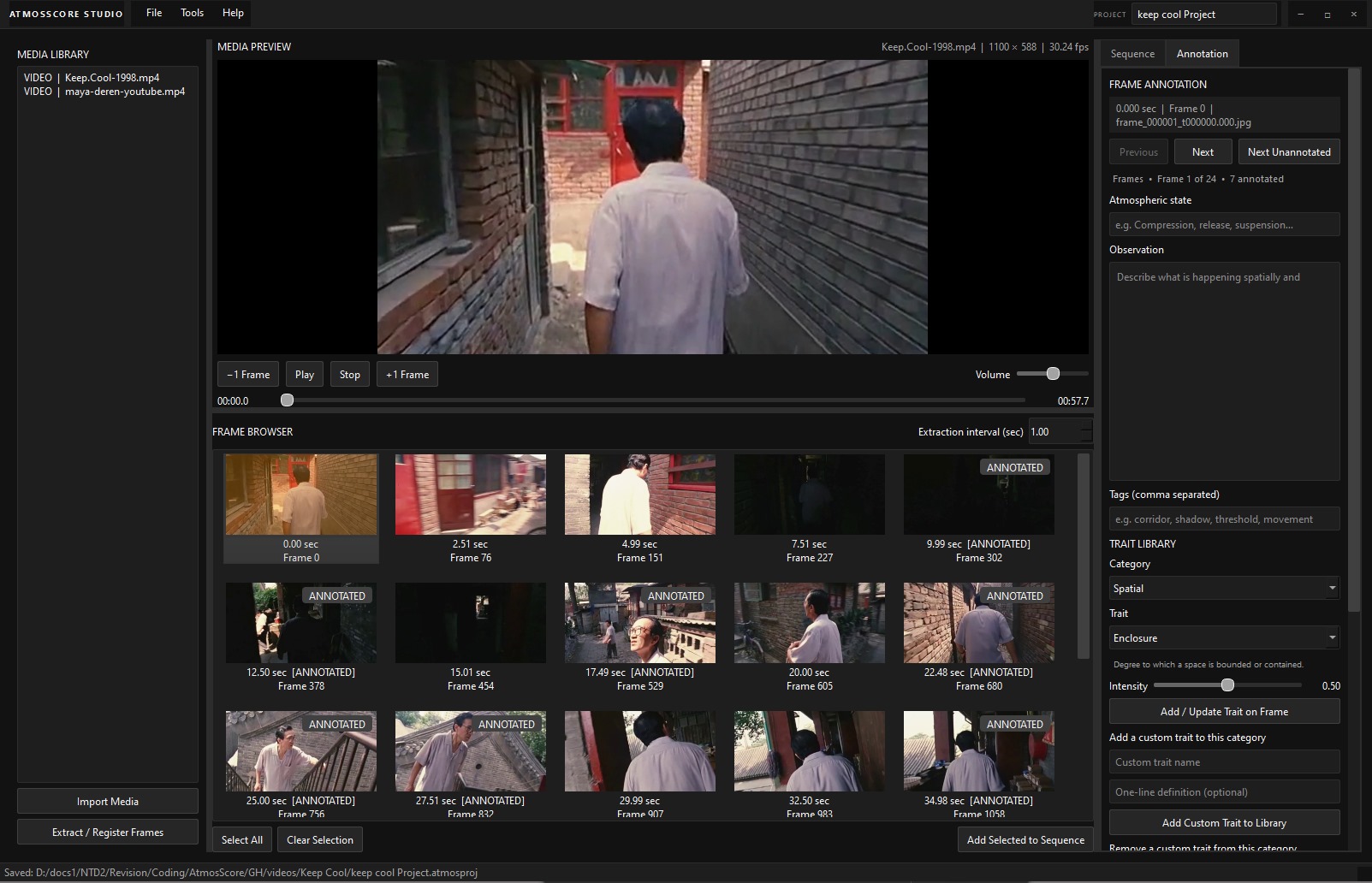
AtmosScore Studio
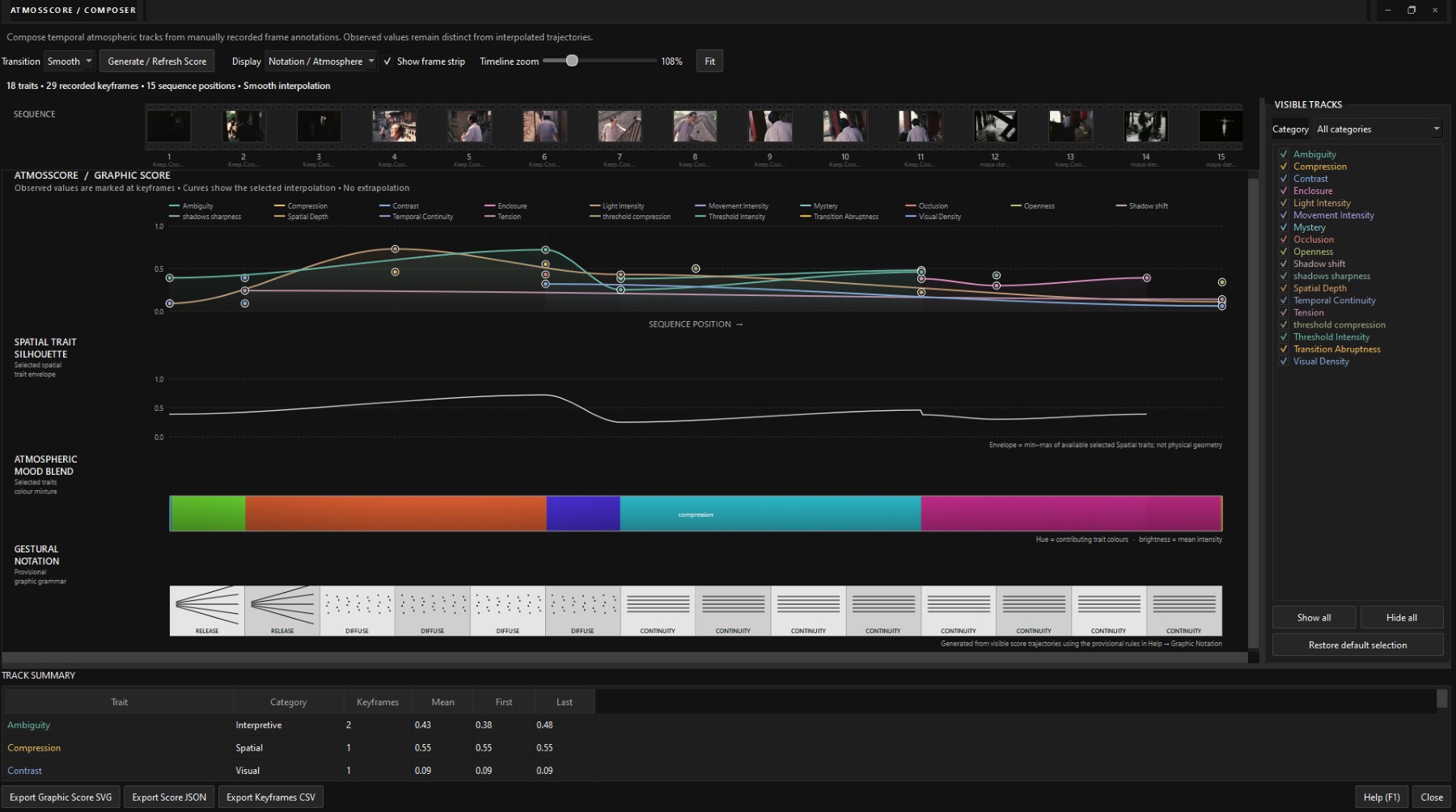
AtmosScore Studio Composer
AtmosScore Early Manual Analysis
The Principle
AtmosScore is an experimental computational design instrument for translating interpreted atmospheric experience into temporal scores and architectural transformations.
A cinematic sequence is not simply a succession of images. It is a temporal organisation of changing conditions: light intensifies or recedes, spaces open or become enclosed, thresholds are crossed, and movement transforms the relationship between a body and its surroundings.
AtmosScore interprets these changes through selected atmospheric traits. Rather than reproducing the appearance of a film directly, it encodes changes in light, enclosure and spatial thresholds as values distributed across time. These values are organised into a score that can inform the transformation of architectural geometry.
Atmosphere is interpreted, organised as a temporal score, and translated into architectural operations.
Film to Architecture
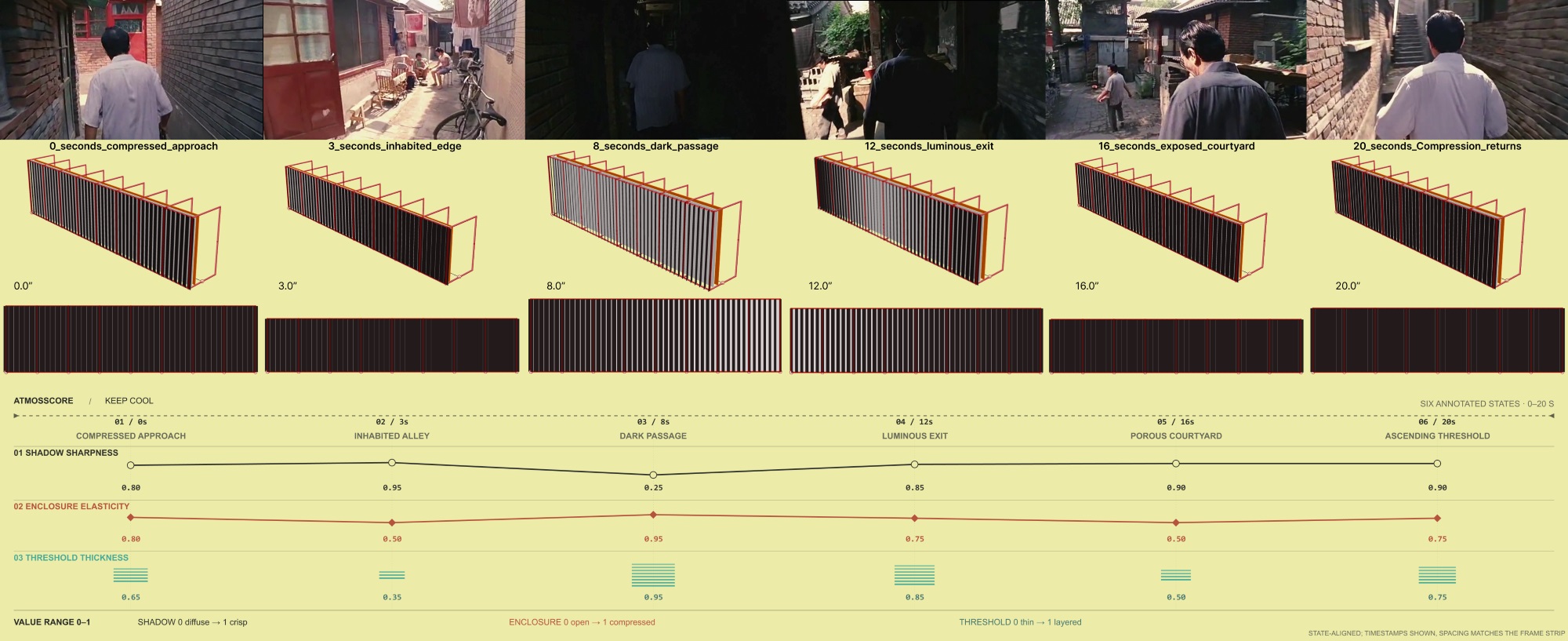
The current prototype has been tested through a six-state sequence from the film Keep Cool. Six selected moments are manually annotated according to changes in the spatial and atmospheric conditions of the sequence.
Three traits currently structure the experiment:
- Shadow Sharpness, describing the transition between diffuse and sharply defined shadow conditions.
- Enclosure Elasticity, encoding changes in the spatial configuration between more open and more compressed conditions.
- Threshold Thickness, encoding changes in the layering and density of spatial thresholds.
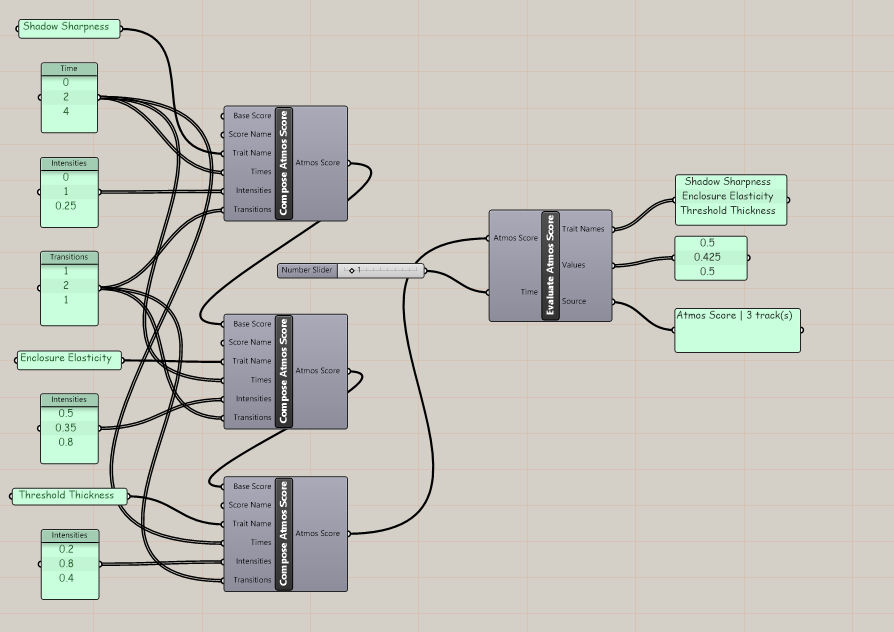
The annotated values are evaluated across time and used to drive architectural geometry. In the current experiment, the score controls the rotation of 48 solid louvres, producing a sequence of spatial configurations in response to changing atmospheric conditions.
The Score as an Instrument
The score has two complementary roles. It makes the interpretation of a cinematic sequence visible through a diagrammatic notation of frames, temporal states, atmospheric traits and transitions. It also acts as an operational interface between interpretation and architectural design.
This approach draws on the idea of a graphic score in music, where notation organises relationships, intensities, durations and transitions. In AtmosScore, the score is not merely a record of an atmospheric experience. It becomes a means of constructing and testing spatial transformations.
Negative Atmosphere
A further research direction investigates negative atmosphere through the relationship between spatial conditions and bodily experience. Restricted movement, interrupted visibility, excessive enclosure, delayed access and spatial estrangement can be examined as interpreted conditions within a temporal sequence.
This opens the possibility of developing a counter-score: an alternative architectural response that modifies selected conditions rather than simply reproducing them. Changes in enclosure, permeability, visibility and circulation could be tested to investigate how architectural configurations might intensify or alleviate these conditions.
Negative atmosphere is therefore approached not as a fixed aesthetic category, but as a relational and temporal problem through which architectural conditions and human experience can be critically examined.
Current Development and Research Direction
AtmosScore currently relies on manual cinematic annotation and a computational workflow developed in Grasshopper. This makes the interpretive decisions explicit and allows the relationship between atmospheric scores and geometric transformations to be tested.
Future development will investigate graphic notation for atmospheric scores, negative atmosphere and the architectural conditions of withholding, and the potential use of computer vision and AI to assist in the interpretation of cinematic material. These directions extend the current prototype rather than describe completed functionality.
AtmosScore investigates how atmospheric experience can be interpreted as a temporal structure, encoded as a score, and used to generate architectural transformation.
The Computational Principle
𝒜(t ) → S(t ) → G(t )
Atmospheric Interpretation
The interpreted atmospheric conditions at time t.
Temporal Score
The score composed from the interpreted atmospheric conditions,
organising their values, durations, and transitions over time.
Architectural Configuration
The resulting architectural configuration at time t.
The expression describes the computational principle of AtmosScore rather than a formal equation already implemented in the plugin. Atmospheric experience is interpreted, the interpretation is organised as a temporal score, and the score informs the transformation of architectural geometry.
The musical-score analogy is central to this approach. A musical score does not merely document a performance after it happens. It organises relationships, intensities, durations, and transitions that can be performed. Similarly, AtmosScore treats atmospheric notation as an operational instrument through which architectural configurations can change over time.
Atmosphere Labs